The Sign of Four
Arthur Conan Doyle's 'The Sign of Four' is a thrilling detective novella that exposes the dark underbelly of the British Empire. It is rewarding to study because it combines an intricate mystery with complex moral questions about justice, greed, and colonial guilt, offering candidates rich material for analysis.
Study Notes
Overview
'The Sign of Four' (1890) is Arthur Conan Doyle's second Sherlock Holmes novel, following 'A Study in Scarlet'. While it functions as a gripping detective story, examiners are looking for candidates who can see beyond the plot to analyse the novella as a critique of Victorian society. The text explores the consequences of the British Empire, particularly the moral corruption brought back to London by those who exploited colonial wealth. Candidates who achieve the highest marks will critically evaluate the relationship between the rational, emotionless Holmes and the moral, romantic Watson, while integrating the historical context of the 1857 Indian Rebellion and the Victorian fear of the 'Other'.
Plot/Content Overview
Chapter 1-3: The ProblemThe novella opens with Holmes injecting a seven-per-cent solution of cocaine out of boredom. Mary Morstan arrives with a case: her father disappeared ten years ago, and she has been receiving anonymous pearls. She has now been invited to a mysterious meeting. Holmes and Watson accompany her.
Chapter 4-6: The DiscoveryThey meet Thaddeus Sholto, who reveals that his father, Major Sholto, and Mary's father found the 'Agra treasure' in India. Major Sholto cheated Morstan and kept it all. Thaddeus's brother, Bartholomew, has found the treasure, but when they arrive at his house, Bartholomew is dead, murdered by a poisoned dart, and the treasure is gone. The 'sign of four' is left at the scene.
Chapter 7-10: The ChaseHolmes deduces that a wooden-legged man (Jonathan Small) and a small accomplice (Tonga) committed the crime. They track them using a dog, Toby, and eventually pursue them in a thrilling steam-launch chase down the River Thames. Tonga is shot dead by Holmes and Watson, and Small's boat crashes. The treasure box is recovered, but it is empty.
Chapter 11-12: The ResolutionSmall confesses that he dumped the treasure in the river so no one else could have it. He explains his backstory: he and three Sikh companions (the 'Four') stole the treasure during the 1857 Rebellion. Major Sholto stole it from them. Small believes the treasure is rightfully his. With the treasure gone, Watson is free to propose to Mary without appearing like a fortune hunter. Holmes returns to his cocaine.
Themes
Theme 1: Imperialism and Colonial Guilt
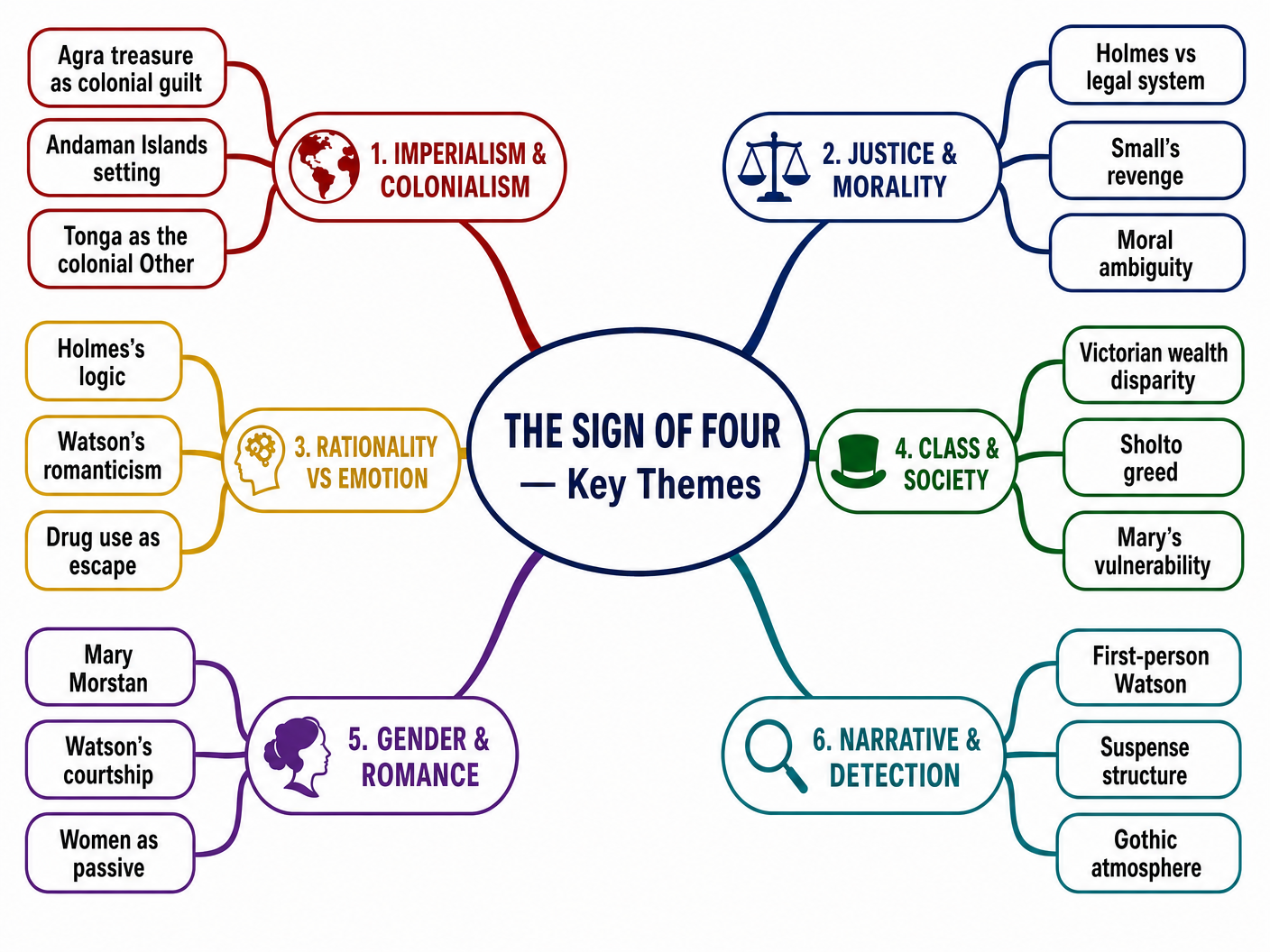
Doyle presents the British Empire not as a source of glory, but as a source of moral corruption and violence. The Agra treasure is cursed; it brings death and greed to everyone who touches it. The invasion of London by foreign elements (Tonga, the treasure, the poisoned darts) reflects Victorian anxieties about the consequences of empire coming home to roost.
Key Quotes:
- "It is an unofficial force — the Baker Street irregulars." (Chapter 8) - Shows Holmes operating outside traditional British institutions.
- "The cursed greed which has been my besetting sin through life has withheld from her the treasure." (Major Sholto, Chapter 4) - Explicitly links colonial wealth with moral corruption.
- "To him it brought murder, to Major Sholto it brought fear and guilt, to me it has meant slavery for life." (Jonathan Small, Chapter 11) - The legacy of the treasure is entirely destructive.
Theme 2: Justice vs. The Law
The novella constantly questions whether legal justice and moral justice are the same thing. Holmes operates outside the official police force (represented by the bumbling Athelney Jones). Jonathan Small is technically a murderer and thief, but he feels entirely justified because Sholto broke their pact. The fact that the treasure ends up at the bottom of the Thames suggests a kind of poetic, moral justice that the courts could not provide.
Key Quotes:
- "I cannot bear to feel that I have paid this price only that another may enjoy it!" (Small, Chapter 11) - Highlights Small's skewed but fiercely held sense of justice.
- "Justice!" snarled the ex-convict. "A pretty justice! Whose loot is this, if it is not ours?" (Small, Chapter 11) - Directly challenges the British legal right to the treasure.
Theme 3: Rationality vs. Emotion
Holmes embodies pure logic, while Watson represents emotion and morality. Doyle uses this contrast to explore the limits of rationality. Holmes solves the case, but he is left isolated with his cocaine at the end, while Watson gains human connection (Mary). The text suggests that pure reason is effective but ultimately cold and unfulfilling.
Key Quotes:
- "Detection is, or ought to be, an exact science and should be treated in the same cold and unemotional manner." (Holmes, Chapter 1)
- "But love is an emotional thing, and whatever is emotional is opposed to that true cold reason which I place above all things." (Holmes, Chapter 12)
- "You really are an automaton — a calculating machine." (Watson to Holmes, Chapter 2)
Character Analysis
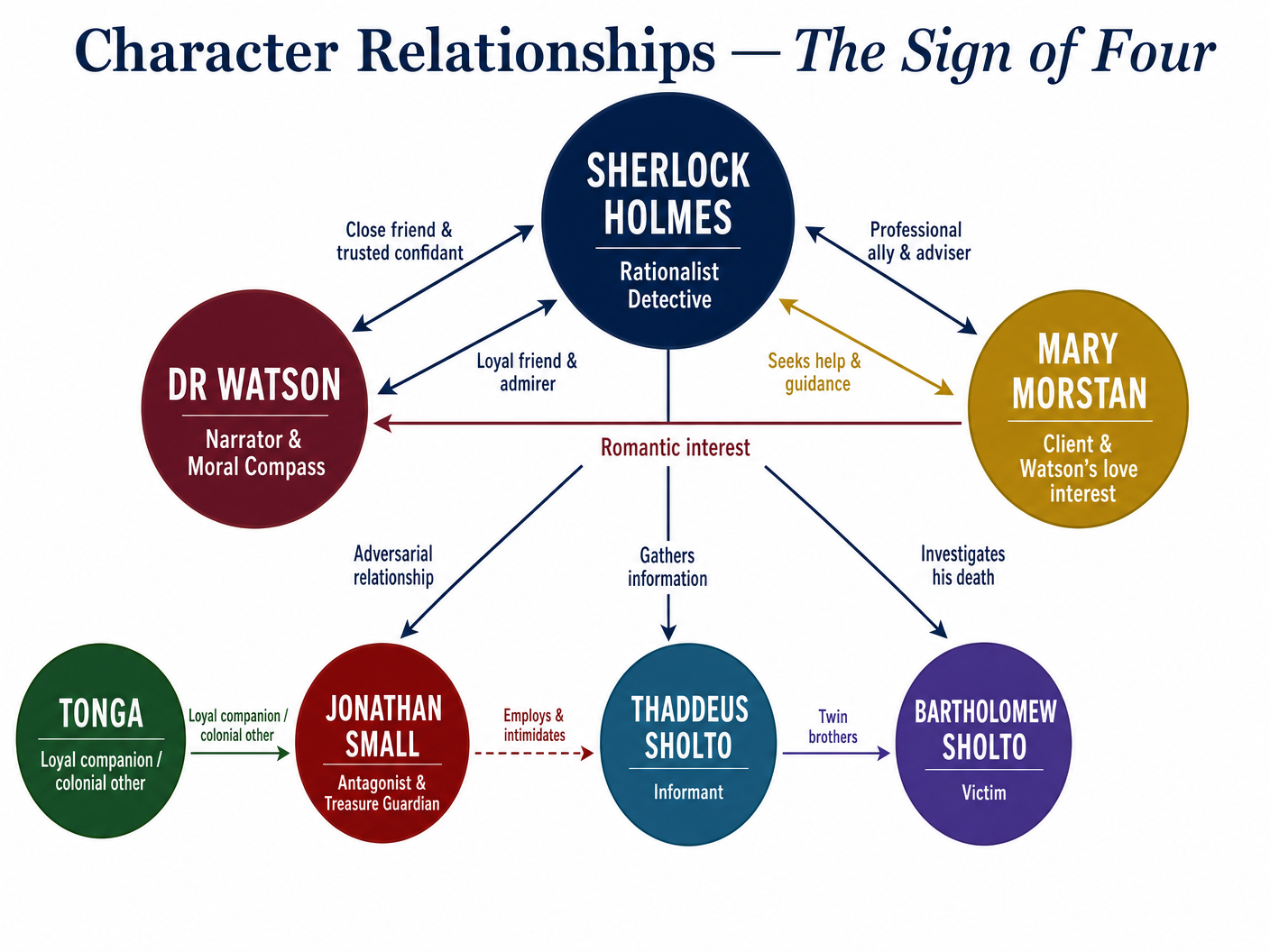
Sherlock Holmes
Role: The rationalist detective who drives the narrative forward.
Key Traits: Brilliant, unemotional, arrogant, dependent on stimulation.
Character Arc: Holmes does not change. He begins the novella injecting cocaine out of boredom, solves the case brilliantly, and ends exactly where he started, reaching for the cocaine bottle because the intellectual stimulation is over.
Essential Quotes:
- "My mind rebels at stagnation. Give me problems, give me work..."
- "I never make exceptions. An exception disproves the rule."
- "For me, there still remains the cocaine-bottle."
Dr. John Watson
Role: The narrator, moral compass, and audience surrogate.
Key Traits: Loyal, romantic, moral, conventional.
Character Arc: Watson moves from being an observer of Holmes's brilliance to an active participant who finds his own reward (love and marriage) outside of the detection process.
Essential Quotes:
- "My conscience swelled within me..."
- "Whoever had lost a treasure, I knew that night that I had gained one."
Jonathan Small
Role: The primary antagonist, though a highly complex one.
Key Traits: Vengeful, loyal (to the Sign of Four), damaged by the empire.
Character Arc: Small spends his life pursuing the treasure, only to realise he can never have it. His confession humanises him and critiques the imperial system that created him.
Essential Quotes:
- "It's been the Sign of Four with us always."
- "I have acted all through for them as much as for myself."
Writer's Methods
Narrative Perspective: The novella is told from Watson's first-person perspective. This is crucial: it limits our knowledge, creating suspense, and filters Holmes's cold logic through Watson's warm, human, and often critical lens.
Setting: Doyle uses London as a Gothic, labyrinthine space. The fog, the muddy Thames, and the dark streets create an atmosphere of moral ambiguity and secrecy. This contrasts with the brief, violent flashbacks to the sun-baked, bloody Andaman Islands and India.
Structure: The narrative follows a classic detective structure (crime → investigation → chase → resolution), but Doyle subverts it with the lengthy flashback in Chapter 11 (Small's story), which shifts the focus from the 'how' of the crime to the 'why'.
Context
The British Empire and the 1857 Rebellion: The 'Indian Mutiny' or First War of Independence forms the bloody backdrop to the Agra treasure. Examiners expect candidates to understand that the treasure represents colonial exploitation.
Victorian Fear of the 'Other': Tonga is described using racist, animalistic language ("savage", "half animal"). This reflects Victorian anxieties about the peoples they had colonised. High-scoring candidates will note that Doyle uses Tonga to embody the threat of the empire invading domestic London.
Decadence and Drug Use: Holmes's cocaine use reflects the 'fin de siècle' (end of century) anxieties about moral decay, decadence, and the limits of scientific progress.
Listen to our full podcast analysis here:
Visual Resources
2 diagrams and illustrations
Interactive Diagrams
1 interactive diagram to visualise key concepts
Conceptual Flow Outline
The Journey of the Cursed Agra Treasure
Worked Examples
2 detailed examples with solutions and examiner commentary
Practice Questions
Test your understanding — click to reveal model answers
Explore how Conan Doyle presents the relationship between Holmes and Watson in 'The Sign of Four'.
Hint: Consider how they act as foils to one another. Look at the opening chapter (cocaine vs medical advice) and the ending (marriage vs isolation).
How does Conan Doyle use the setting of London to create atmosphere in the novella?
Hint: Think about the fog, the labyrinthine streets, and the River Thames. How do these reflect the themes of the book?
Explore the presentation of Mary Morstan in 'The Sign of Four'.
Hint: Look at how she is introduced as the 'Victorian ideal' of a woman, but also how she handles the stress of the case and the loss of the treasure.
How does Conan Doyle present the theme of greed in the novella?
Hint: Focus on Major Sholto, Bartholomew Sholto, and Jonathan Small. Contrast them with Holmes and Mary.